
Mulitas vs Vampiros: What’s the Difference?

what you need to know • Mulitas are two corn tortillas with melted cheese and meat sandwiched between them, griddled until crisp. Think tortilla sandwich. • Vampiros use one corn tortilla toasted until crunchy, then topped open-face with melted cheese, meat and salsa. • Where they come from: mulitas are most often credited to Tijuana and Baja California. Vampiros trace back to Sinaloa. • The quick rule: two tortillas and a sealed middle is a mulita. One crispy tortilla with everything piled on top is a vampiro. • At Tacomasa, both come with asada, adobada, pollo asado, nopal, tripa, lengua or just queso, served con todo. |
Last updated: October 21, 2026. Written by the Tacomasa team.
Mulitas and vampiros sit next to each other on almost every Southern California taqueria menu, and they both promise the same thing: corn tortillas, meat and a lot of melted cheese. So what’s the actual difference?
It comes down to how many tortillas you get and where the toppings go. Here’s the full breakdown, plus how to pick the one you’ll like best.
What is the difference between mulitas and vampiros? A mulita is two corn tortillas with cheese and meat sealed between them, like a sandwich. A vampiro is one corn tortilla toasted crunchy and topped open-face with melted cheese, meat and salsa. Mulitas are hearty and closed; vampiros are crisp and open.
What are mulitas?
Mulitas are a taqueria dish made from two corn tortillas stacked flat with cheese and chopped meat in the middle, then cooked on a griddle until the cheese melts and holds the whole thing together. The result is a tortilla sandwich you can pick up with one hand.
Picture a grilled cheese sandwich, but the bread is a double tortilla and the filling is carne asada. That’s a mulita. The melted cheese works like glue, and wherever it spills onto the griddle it fries into a crunchy edge.
Food writers and taqueros most often credit mulitas to the taquerias of Tijuana and Baja California, according to this mulitas history from AmigoFoods. From the border they spread into Southern California taco shops and trucks, where they’re now a fixture of Tijuana street food style menus.
What are mulitas de asada?
Mulitas de asada are mulitas filled with carne asada, grilled and chopped steak. Asada mulitas are the version most taquerias lead with, because the smoky, salty beef stands up to all that cheese.
What is a vampiro taco?
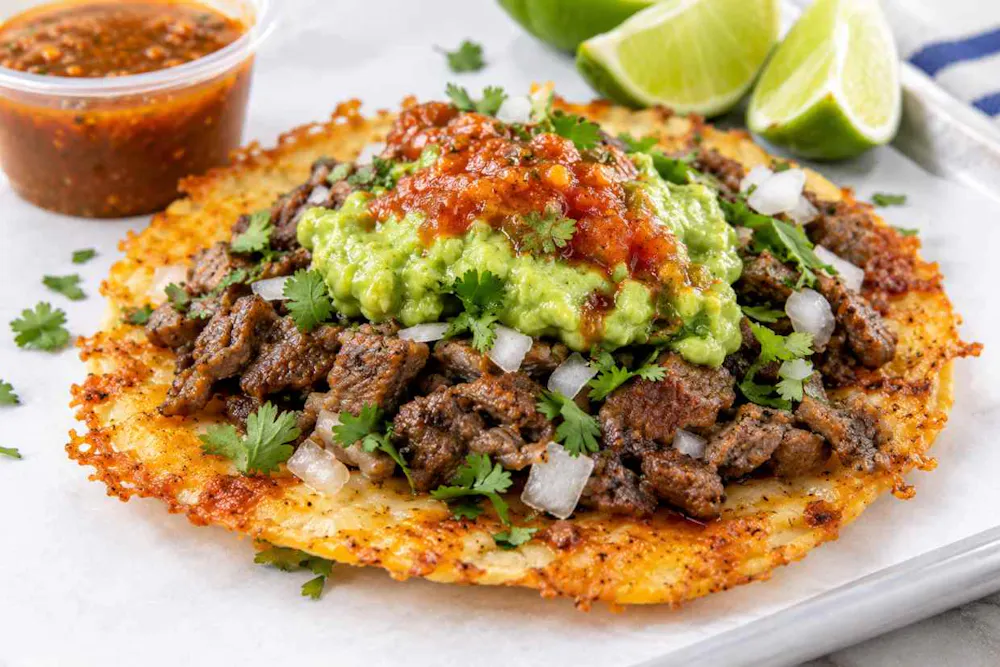
A vampiro is a single corn tortilla toasted on the griddle until it’s firm and crunchy, then topped with melted cheese, meat and salsa. It’s served open-face, so you see everything on it.
Think of it as the open-face sandwich to the mulita’s closed one. Same ingredients, very different bite: a vampiro shatters, while a mulita bends and stretches.
Vampiros come from Sinaloa, the state on Mexico’s northwest coast. The original Sinaloa version is topped with minced cabbage, red onion and a thick red salsa.
Sinaloa food culture runs deep in Southern California. Writing for Taste, a reporter traced vampiro taqueros back to Culiacán, the capital of Sinaloa, and to the Sinaloan communities around Compton and Paramount. Locals there even call people from Culiacán culichis.
Mulitas vs vampiros: how do they compare side by side?
The main difference between mulitas and vampiros is structure: mulitas close the filling between two tortillas, and vampiros pile it on top of one. Everything else, from texture to how you eat it, follows from that.
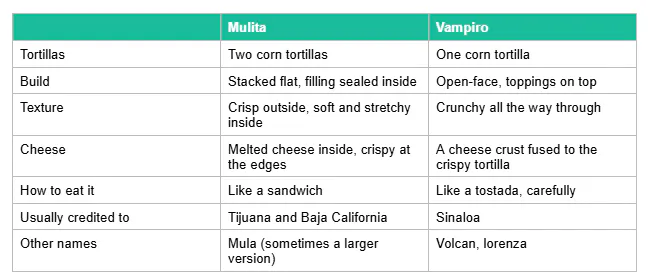
The cheese crust is the part people get hooked on. On a vampiro, the cheese melts straight onto the crispy tortilla and turns golden, so every bite has crunch from two layers instead of one.
Which one should you order?
Order a mulita if you want something hearty that holds together and won’t drop toppings on your shirt. Order a vampiro if you love crunch and want to taste the salsa and toppings up front.
We’ll be straight with you: if it’s your first time, get one of each with the same meat. That’s the fastest way to feel the difference, and it’s usually the order that turns a first-timer into a regular.
A few more decision triggers:
Eating in the car or on the go: mulita. It’s sealed, so it travels better.
Loading up on salsa: vampiro. The open top gives salsa somewhere to sit.
Ordering a softer meat like lengua: mulita. The cheese keeps it all in one bite.
Ordering a crispy meat like tripa: vampiro. Crunch on crunch.
How do mulitas compare to a quesadilla?
Mulitas vs quesadilla comes down to shape and fillings. A quesadilla is usually one tortilla folded in half around cheese, while a mulita is two tortillas stacked flat and loaded with meat as well as cheese.
If a quesadilla is a folded grilled cheese, the mulita is the double-decker version. Some people even call the vampiro a grilled cheese taco, since the cheese gets griddled right onto the tortilla. Both are cousins of the quesadilla, just built for more meat and more crunch.
What fillings can you get on our mulitas and vampiros?
Our taqueria menu offers mulitas and vampiros with the same seven fillings: carne asada (steak), adobada (marinated pork), pollo asado (grilled chicken), nopal (cactus), tripa (beef tripe), lengua (beef tongue) or queso (cheese only). Every one is listed on our current menu.
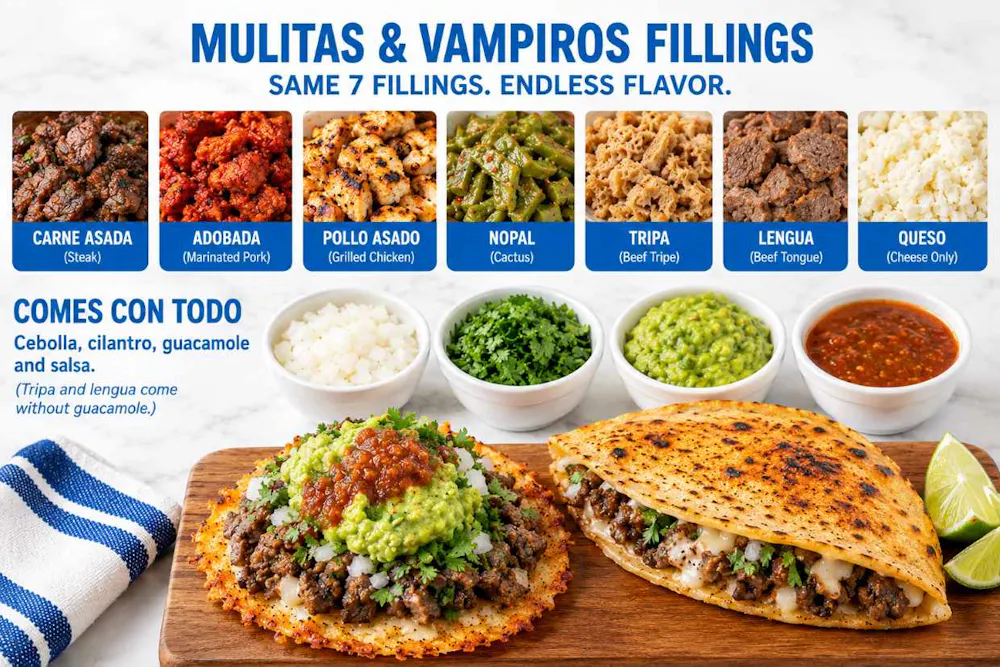
Both come con todo, which on our menu means cebolla, cilantro, guacamole and salsa. Tripa and lengua come without the guacamole. If you’re new to the phrase, our guide to what con todo means covers it.
Torn between steak and pork? Our carne asada vs adobada comparison explains the flavor difference. If you want a meatless pick, nopal is worth trying, and our post on what nopales taste like tells you what to expect.
Where can you try mulitas and vampiros in Southern California?
You can order mulitas and vampiros at every Tacomasa location in Long Beach, Cypress, El Segundo and Brea. Check hours and addresses on our locations page.
They’re also an easy add-on for groups. Our catering options cover platters, burritos and tortas for parties and office lunches.
Frequently asked questions
Are vampiros tacos the same as volcanes?
Mostly, yes, because the name changes by region. Vampiro is the Sinaloa name, and Los Angeles Magazine reports they’re called volcanes around San Luis Potosi. Sonoran shops may call them lorenzas, but the crispy, cheese-topped tortilla is the same idea.
Why is it called a vampiro?
Nobody knows for sure, and that’s half the fun. Popular theories say the toasted tortilla curls like a bat wing, or that red salsa runs down your chin like blood. San Diego Magazine credits the vampire-repelling garlic in the meat.
Why are mulitas called mulitas?
Mulita means “little mule” in Spanish. The most common explanation is that, like a pack mule, the mulita carries a heavy load between its two tortillas. There’s no documented origin for the name, so treat it as taqueria folklore rather than history.
Is a vampiro the same as a tostada?
No. A tostada starts with a tortilla that’s already fried or baked crisp. A vampiro tortilla is toasted fresh on the griddle until firm, then gets a layer of melted cheese before the toppings go on. That fresh toast and the cheese layer are what separate the two.
Is the vampiro Mexican food or Tex-Mex?
The vampiro is Mexican food, born in Sinaloa and carried north by Sinaloan taqueros. In Southern California it picked up guacamole from Tijuana-style taco shops, so the version you’ll find here blends two northern Mexican traditions. It has nothing to do with Tex-Mex.
Can you get mulitas or vampiros without meat?
Yes. At Tacomasa you can order either one with queso only, or with nopal (cactus) for a meatless option that still has plenty of texture. Both still come con todo with cebolla, cilantro, guacamole and salsa.
The bottom line
Mulitas and vampiros share the same ingredients but not the same build. Mulitas are two tortillas with cheese and meat sealed inside; vampiros are one crunchy tortilla with everything on top.
Our advice is to order both with the same filling and decide for yourself, then come back for the one you can’t stop thinking about. Everything is on our Tacomasa menu.
Last updated: October 21, 2026